
Hill County Parole Versus Probation
Parole follows confinement in a Texas Department of Criminal Justice prison. A person leaves physical custody but serves the remaining sentence under rules enforced by the TDCJ Parole Division. Mandatory supervision is another statutory form of supervised prison release. Probation, formally called community supervision in Texas, comes from a court order. It may be imposed without any TDCJ prison term. Hill County Community Supervision and Corrections Department, or CSCD, administers adult probation ordered in local cases.
A person who bonds out of the Hill County Jail has been released from jail, but bond is not parole or probation. The court may later impose probation, dismiss the charge, enter a prison sentence, or reach another disposition. Start with the custody system and the court case instead of inferring supervision from a release date.
| Record question | Parole | Probation |
|---|---|---|
| Who orders it? | Texas parole system after a prison sentence | The sentencing court |
| Who supervises it? | TDCJ Parole Division | Hill County CSCD |
| Best first record | TDCJ status and parole inquiry | Judgment and Hill County docket |
| How it ends | Discharge from sentence or supervision | Court discharge or completion order |
- Parole
- Conditional release from prison while the sentence remains active.
- Probation
- Court-ordered community supervision, which may replace confinement.
- Discharge
- The documented end of a sentence or supervision term.
- Absconder
- A person alleged to have stopped reporting or complying; the status must be verified officially.
Check Hill County Supervision Status
There is no public Hill County probationer search, absconder list, or warrant list in the official sources reviewed. The CSCD client portal also is not a public lookup. It requires a Web ID supplied by the supervising officer. Verification therefore moves through the agency that owns the record. Use full name, date of birth, cause number, and TDCJ or state identification number when known.
- Identify whether the underlying case produced a TDCJ prison sentence, local probation, or only a jail release.
- For parole, use the TDCJ parole inquiry channel and the county-to-office directory.
- For probation, search the Hill County court portal for the judgment and later docket activity.
- Contact the assigned office with identifiers. Ask for the current public status, not private case details.
- If supervision ended, request the discharge record or final court order from the responsible custodian.
VINELink can report a county custody change, and TDCJ IVSS can provide eligible post-conviction notices. Neither is a public list of everyone under Hill County supervision. A missing live profile also does not prove discharge. Historical confirmation requires the agency record.
Hill County Probation Office
The Hill County probation page identifies the local CSCD and links its authenticated reporting route. The official information guide lists Monday through Thursday hours of 7 a.m. to 6 p.m. People already assigned to CSCD should use the reporting method given by their officer. Members of the public should not try to enter the client portal without credentials.
126 South Covington Street
Hillsboro, TX 76645
Phone: 254-582-4075
Fax: 254-582-4039
Hours: Monday through Thursday, 7 a.m. to 6 p.m.
The court record remains essential. It can show whether community supervision was imposed, modified, revoked, or discharged. A certified copy may be obtained from the District Clerk when formal proof is needed.
Hill County Violations and Warrants
Supervision conditions come from the court order or parole certificate. They can include reporting, travel limits, treatment, program participation, fees, and rules tailored to the case. Only the controlling document and supervising agency can state the actual terms. A claimed violation may lead to an officer report, a warrant, a motion to revoke, or renewed custody, but those steps are not interchangeable.
An absconder is generally someone alleged to have stopped reporting or complying. Do not apply that label from a missed appointment, an old post, or an unofficial directory. Check the Hill County docket for a motion, capias, warrant-related entry, or revocation proceeding, then contact CSCD or TDCJ as appropriate. VINELink may help with a later jail custody event. It does not decide whether a supervision violation occurred.
When Hill County Supervision Ends
Physical release occurs when a person leaves a jail or prison. Supervision can continue well beyond that day. A parolee may remain subject to TDCJ rules until discharge from the sentence. A probationer remains under the court order until completion, early termination, revocation, or another court action. The final record is therefore more useful than the date a person first returned to the community.
For completed parole, request the public portion of the release and discharge history through the TDCJ Public Information Act channel. For completed probation, obtain the final docket entry and signed order from the Hill County District Clerk. Texas Government Code Chapter 552 governs requests for existing public information, subject to exceptions. It does not require an office to create a new answer or disclose protected material.
The Hill County released-inmate search and records overview explains how the jail release record, court disposition, and state discharge record fit together. Those records answer different parts of the same timeline.
Hill County Parole Reports in Waco
Hill County parole cases do not map to a parole office in Hillsboro. The TDCJ county cross-reference assigns them to the Waco District Parole Office in Region IV. The Region IV directory supplies the address and telephone number, while the District Reentry Center directory confirms Waco coverage for Hill County.
5401 North State Highway 6
Waco, TX 76712
Phone: 254-848-2547
Fax: 254-848-2572
This local split is important. Hill County CSCD in Hillsboro handles probation. The Waco office handles assigned TDCJ parole matters. Calling one office about the other system can delay a status check and may produce no record at all.
The official Hill County probation channel is shown below. Its page helps distinguish the Hillsboro CSCD from the Waco parole assignment.
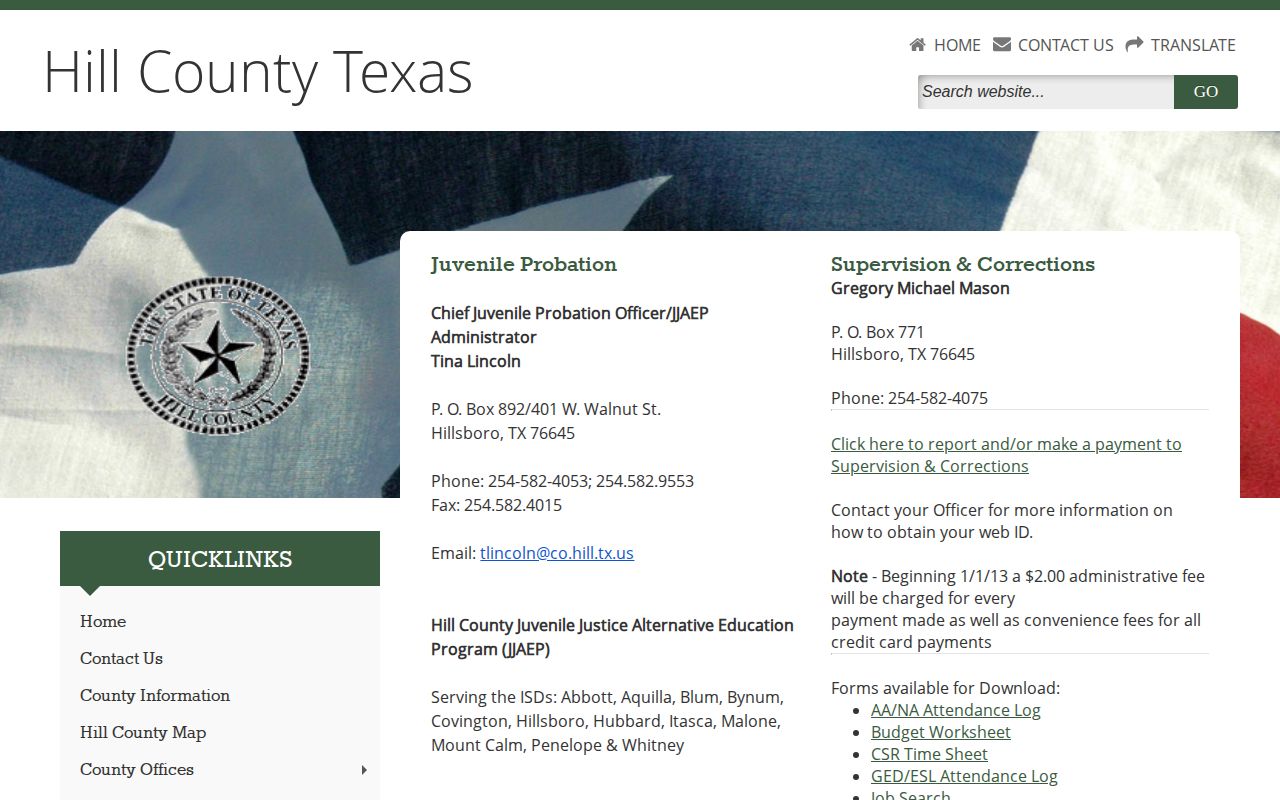
The county page is an agency contact route, not a public list of people on probation.
Hill County Parole Review Process
The Texas Board of Pardons and Paroles usually reviews an individual case through a file-vote process, not a public hearing at the Hill County courthouse. TDCJ generally identifies a case about six months before initial eligibility and about four months before a later review. An institutional parole officer interviews the person and prepares a summary. Three panel members vote in sequence, and two matching votes establish the result.
No official public calendar or searchable results database for individual cases was found. Texas Secretary of State open-meeting notices concern Board workshops and administrative meetings. They are not inmate case dockets. Before a vote, individual status is available at 844-512-0461. After a favorable vote, release-processing questions go to 512-406-5202. A caller should have the TDCJ number, SID, or date of birth.
Official vote codes need careful reading. FI-1 means release when eligible. FI-2 sets a future specified month or date. Some FI-R and FI results depend on treatment or programs. NR sets a later review, SA means serve the balance, and DMS denies mandatory supervision. The Board vote-options key controls the meaning. Approval may be withdrawn if new information changes the case.
Hill County Parole Eligibility
Eligibility is the first point when review may occur. It is not a promised release date. Texas Government Code sections 508.145 and 508.149, the offense date, sentence, statutory exclusions, and other case facts drive the calculation. Certain violent or aggravated categories may require actual calendar time equal to half the sentence or 30 years, whichever is less, subject to a two-year minimum. Other offenses and dates follow different rules.
Texas has no blanket rule requiring every prisoner to serve 85 percent. Good-conduct time may affect eligibility or mandatory-supervision calculations where law allows, but it does not shorten the sentence pronounced by the court or guarantee parole. The Board's Parole in Texas handbook should be read with the current statute and the specific offense date.
At the end of any search, match identity and jurisdiction. A Hill County arrest can lead to county probation, TDCJ parole, transfer, or no supervision at all. Each path has its own custodian and final record.
Search Public Records
Sponsored Results